
NIH explores capping APCs: Let’s look at the evidence
On April 30 2025, the US National Institutes of Health (NIH) director Jay Bhattacharya released a statement accelerating the timeline for the new Public Access Policy, kicking up a flurry of activity and discussion about open access (OA). The new policy, in effect since July 1 2025, requires immediate OA without allowing for the 12-month embargo period that publishers have long claimed as necessary for sustaining subscriptions. The removal of the embargo, while accelerated, has been a long time coming. Publishers have been preparing by shifting their business models from subscriptions to Article Processing Charges (APCs) and, more recently, to so-called “Read-and-Publish” agreements, which are essentially APCs bundled together with subscriptions.
Our previous work on APCs
Our compiled data and estimates revealed how publishers use APC pricing strategically, and almost certainly in ways that do not reflect the true cost of publishing.
Well before this latest move by the NIH, we at the ScholCommLab have been meticulously working to better understand commercial publishers’ use of APCs. Our team has compiled datasets of price lists from publishers (see data for 2015-2018 and for 2019-2023) and, just over a year ago, published what we believe to be the most accurate estimate of how much is paid in APCs to some of the largest scholarly publishers: around US$2.5 billion in 2023, just to the largest 5 publishers. Our compiled data and estimates revealed how publishers use APC pricing strategically, and almost certainly in ways that do not reflect the true cost of publishing. In addition to confirming a growing adoption of APCs, we found that APC prices have been escalating: 89% of journals increased their APCs from 2019 to 2024, with 40% of fees rising faster than inflation.
What fees are "reasonable"?
Unsurprisingly, we have not been the only ones concerned with how publishers choose to set APCs, and whether these fees are warranted. The organization Invest in Open Infrastructure, with the support of one of our co-authors (ES), has been conducting research on “reasonable costs” for public access, including how institutions currently pay for publishing research articles and data, what workflows are being adapted in preparation for public access mandates, and how those costs vary across different types of institutions. More recently (on 8 July 2025), the NIH announced its intent to put a cap on APCs allowable by its grants, in an effort to ensure that these remain “reasonable.”
NIH requests information
To support the process of determining what an appropriate amount to spend on publication fees is, the NIH has put out a Request for Information (RfI), open until 15 September 2025, in which they ask the community to comment on five different scenarios. These include not allowing APCs at all or placing a cap of either $2,000, $3,000 or $6,000 per publication. Other potential scenarios include upper limits of publication costs as a fixed amount or proportion of the overall grant, or considering whether publishers pay peer reviewers.
To support readers wanting to respond to the NIH’s RfI, we collected updated APC list prices from several major publishers and analyzed what proportion of NIH-funded articles were in journals that charged APCs above the proposed cap amounts. The dataset we created for this analysis can be found in the ScholCommLab Dataverse. Our methods and results are described below.
Identifying NIH-funded papers
In order to identify journals where NIH-funded authors published, we queried Dimensions for journal research articles published in 2025 which acknowledged funding from NIH. The data was exported from the web interface on 24 July 2025 using the following filters:
- Funder Group = NIH
- Publication Type = Article
- Document Type = Research Article or Review Article
- Publication Year = 2025
The query returned 58,996 papers acknowledging funding from the NIH indexed up to the query date. We assume that this is just over 50% of all journal articles to be published in 2025. We aggregated all articles and reviews per journal, obtaining a list of 6,126 individual publication venues.
Collecting current APCs
On the same day, we retrieved the current APC price lists from the websites of nine large publishers (Cambridge University Press, Elsevier, Frontiers, MDPI, Oxford University Press, PLOS, Sage Publications, Springer Nature, Wiley). We then matched the publication venues to the APC found in the price lists by merging on ISSN. A quality check was also done by comparing matched journal name strings using Levenshtein distance, and discrepancies were manually investigated and corrected (mostly due to the use formatting or the inclusion/exclusion of the journal subtitle).
Journals that were published by other publishers (n=1,935) and those that could not be matched automatically by ISSN (n=298) were investigated manually by retrieving the APC and OA status from the journal or publisher website. Due to the large number of journals with at least one article and the usual skewed distribution (see Bradford’s law), we decided to limit the analysis to journals that had published a minimum of 5 articles with NIH funding in 2025. We also deleted a few entries that were monographs or other formats rather than journals. This threshold limited our analysis to a total of 2,228 journals, which represent 36% of journals but 87% of NIH papers in 2025 so far. (The 3,848 additional journals with less than 5 papers each are seemingly less relevant publication venues for projects funded by NIH.)
Effect of potential policy scenarios
Our analysis of the 2,228 journals confirms the trend seen in our previous data of the top 199 journals (shared with Science for this story). Overall, we find that current publishing practices result in NIH funded research published primarily in journals with fees far above the lowest of the proposed caps and in some cases even above the highest (Figure 1).

Scenario 1: Capping APCs at $2,000
More specifically, the fees for a few as 7% (=162) journals (or 6% of papers) would be fully covered by a $2,000 cap. This includes journals without any or lower APCs such as Investigative Ophthalmology & Visual Science (APC=$1,950) published by the Association for Research in Vision and Ophthalmology (ARVO), STAR Protocols ($1,550) published by Elsevier, Imaging Neuroscience ($1,600) published by MIT Press or microPublication Biology ($350) published by Caltech Library. (Imaging Neuroscience was launched two years ago by the former editorial board of NeuroImage ($3,540) after resigning from Elsevier over what they considered unethical and unsustainable APCs.)
Scenario 2: Allowing up to $3,000 OA fees
The proposed cap of $3,000 would fully cover the publication fees for 566 journals, which would increase the fully covered publications from 7% to 25% of journals and from 6% to or 21% of papers acknowledging NIH funding. Even a generous $6,000 cap would still leave some journals with partially uncovered APCs. Any cap would mean that authors will have to fund the remaining amount not payable from the NIH grant from other sources, such as library funds or personal spending accounts.
Scenario 3: NIH would pay up to $6,000 per paper
A $6,000 cap would not be sufficient to cover the APCs of 10% of papers (=4,908 in 2025 so far) in 104 (=5%) journals. These include 28 Nature hybrid journals (e.g., Nature, Nature Medicine, Nature Genetics, Nature Neuroscience) at $12,690, Elsevier’s Cell at $11,400 (hybrid) or the gold OA journal Nature Communications at $6,990 (the only gold OA journal with an APC above $6,000).
While the list of journals with APCs of $6,000 and above mostly includes journals from for-profit publishers (89%), eleven of them are hybrid journals published by non-profit societies. This includes, for example, the Journal of Neuroscience ($6,270) by the Society for Neuroscience, the American Association for Cancer Research’s Clinical Cancer Research ($8,000) or Blood ($6,600) published by the American Society of Hematology.
Hybrid more expensive than gold
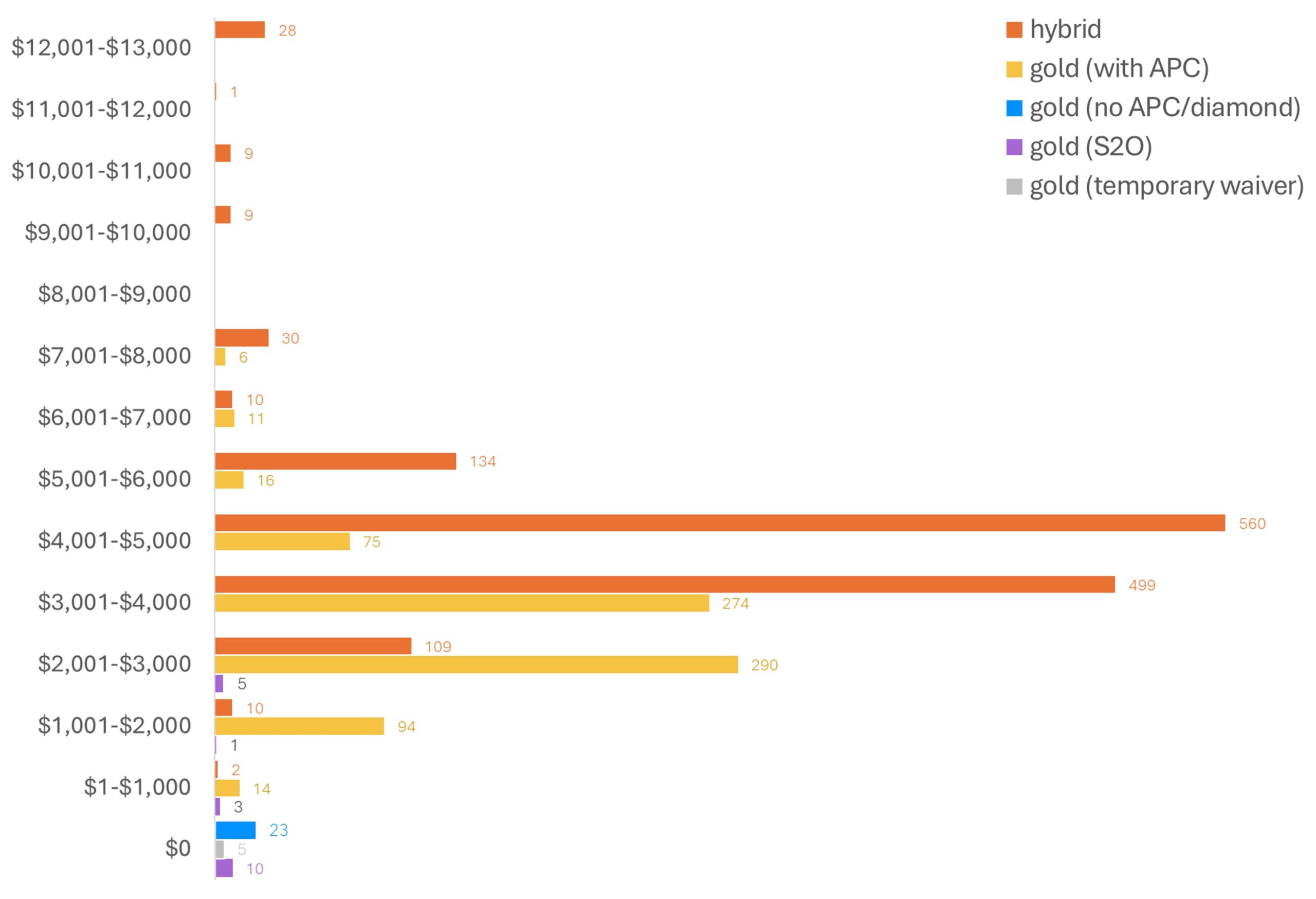
As shown in Figure 2, OA fees for hybrid journals are more expensive than publishing in gold OA journals. This is a well-known, though counter-intuitive fact, as gold journals are usually exclusively funded via the author-pays model, while hybrid journals are primarily financed by library subscription fees with papers locked behind paywalls by default. Under the hybrid model, authors have the choice to remove the paywall for their individual paper through an APC payment.The average APC of all journals with at least 5 NIH-funded papers in 2025 analyzed here is $3,878, with hybrid journals charging on average $4,425 and gold OA journals charging on average $3,106. These fees are higher than the averages reported by recent studies such as ours ($2,000 for gold, $3,230 for hybrid journals), which may be due to recent fee increases and the disciplinary focus on biomedicine and health, where APCs tend to be higher than in STEM or SSH.
Journals without APCs: diamond, S2O and temporary waivers
Interestingly, 38 journals did not require an APC payment for OA in 2025, 23 of which because the journal production costs were covered by a third party (diamond OA), 10 raised via Subscribe to Open (S2O) and 5 because APCs were temporarily waived. The latter seems to be a popular marketing instrument by publishers for new gold OA journals. For example, as we reported earlier, over half of the 155 journals from our 2015-2018 APC dataset that had temporarily waived APCs, had introduced a fee by 2023.
There is a significant gap between what the NIH is proposing as reasonable caps and the substantially higher charges imposed by publishers of journals where NIH-funded authors most frequently publish.
Conclusion
Although our analysis cannot determine whether publishers’ fees are “reasonable,” it makes one conclusion unmistakably clear: there is a significant gap between what the NIH is proposing as reasonable caps and the substantially higher charges imposed by publishers of journals where NIH-funded authors most frequently publish. This gap is likely even greater than our analysis indicates, since prior to the zero-embargo of the new policy, some authors included in the data had not paid APCs but instead complied by depositing their articles in PubMedCentral at no cost (green OA). Any of the proposed scenarios would disrupt the current system: publishers would face pressure to adjust either fees or policies, while authors would either scramble to cover shortfalls or seek alternative publishing venues.
As the NIH weighs these options, it remains debatable whether capping APCs is the most effective way to rein in unreasonable publishing fees or if such caps risk acting as a band-aid on symptoms rather than curing the underlying disease of profit-making that is plaguing scholarly publishing.
If you would like to share feedback or discover any issues, please get in touch with Stefanie.
Data
We invite you to look at and scrutinize our data. It is available for download and to be reused for any purposes (CC-0):
Haustein, S., Schares, E., Alperin, J.P., Camargo, F., Matthias, L., Céspedes, L., Poitras, C., & Strecker, D. (2025). APCs of 2,228 journals where NIH-funded authors published in 2025 (Version v1) [dataset]. Harvard Dataverse. https://doi.org/10.7910/DVN/3XDMNF
DOI: https://doi.org/10.59350/scholcommlab.5645

ScholCommLab signs Barcelona Declaration
At the ScholCommLab, we believe that information about research outputs—such as publications, funding, and data—should be open, transparent, and community-governed. That’s why we are proud to sign the Barcelona Declaration on Open Research Information. We already did so in the fall of 2024, but we’re happy to explain the background in this blog post.
The Declaration outlines four key commitments:
- Making openness the default for the research information we use and produce.
- Working with services and systems that support and enable open research information.
- Supporting the sustainability of open infrastructure.
- Supporting collective action to accelerate the transition to openness of research information.

These principles align closely with our research agenda and our values rooted in open science. Through our collaborations and exchanges with organizations like OpenAlex and Crossref, lab members actively support efforts to build open, transparent scholarly metadata ecosystems and have been doing so for quite a while.
For example, Juan has been supporting PKP to offer the OJS open source publishing suite. Juan is also a member of COMET (Collaborative Open Metadata for Education and Research), a task force working to advance collective, community-owned metadata solutions.
Signing the Barcelona Declaration means that ScholCommLab members will:
- Prioritize, if possible, the use of open research information sources in projects;
- Developing tools and studies that promote responsible, open research and evaluation practices;
- Advocating for sustainable, non-commercial infrastructures to support the scholarly community.
Signing the Barcelona Declaration is a natural extension of our ongoing commitment to making scholarly communication more equitable, transparent, and inclusive—not just in research outputs, but in the infrastructures that underpin them.
DOI: https://doi.org/10.59350/scholcommlab.5406