

Advice for a Preprint Services Directory
As we recently wrote, there is really no agreed-upon definition of what a preprint is. And even if we could agree, it would not settle the question of what constitutes a preprint server. As we have been looking to study preprints and their role in scholarly communications, we have been looking to generate a directory of servers that, even if flawed or limited, can give us a common starting point for examining preprints and the culture around them.
Unsurprisingly, we are not alone in this. ASAPbio, an organization dedicated to promoting the use of preprints, is looking to update their directory of preprints. We shared some of our insights with them, and thought some of our feedback might also be more useful to the broader community.

Need to work from a definition
Most importantly, any directory will need to operationalize their definition of what constitutes a preprint server.
Our own attempts at constructing a list of preprint servers indicates a wide range of platforms and publishers allow authors to post preprints, but whether these should be called “preprint servers” is far from settled. Researchers can post preprints to venues dedicated exclusively to preprints; publish/review/curate platforms; journal-based platforms that publish both preprints and peer-reviewed articles; general repositories that accept preprints among other types of research outputs; and the list goes on.
While there may not be a single or right answer to “what is a preprint server,” a directory cannot function as a meaningful community resource without a clear operational definition. Its creators must explain what is included, what is excluded, and why.
Detail is necessary
A useful directory needs more than just a list of venues and services—it requires descriptive information that lets users filter and understand the landscape. The challenge lies in how one captures that information. When assessing whether a server has a particular policy, a simple "yes” or “no” indicating whether a policy is "clear" tells only part of the story. A policy can be clear without being specific, and policies that appear similarly clear can differ substantially in their actual terms.
In our own analysis, we encountered exactly this problem. Instead of forcing policies into binary categories, directories should specify which characteristics matter for each policy area, then document those details explicitly. For example, rather than simply recording whether a server has a withdrawal policy, a directory should indicate who can request a withdrawal, under what circumstances, and how the withdrawal is reflected in the scholarly record. Leave fields blank where no clear policy exists—but do the work of showing what the policy actually says.
Conclusion
Building a useful directory of preprint servers is more complex than it might initially seem. It requires not just listing which servers exist, but making deliberate choices about which definitions to use and then describing policies with enough nuance that researchers and other stakeholders can actually make informed decisions. Without this intentionality—both in definition and in detail—directories risk becoming incomplete or misleading resources. The good news is that the current moment offers an opportunity to get this right.
DOI: https://doi.org/10.59350/zqh03-rx293


Defining Preprints and Preprint Servers: Mapping an Inconsistent Landscape
A term without a settled definition
The term “preprint” is widely used in scholarly communication, but it does not have an agreed-upon definition across disciplines, platforms, or professional roles.
The National Information Standards Organization (NISO) broadly defines a preprint as a scholarly article made publicly available before it has been peer reviewed, accepted for publication, or formally endorsed. Yet NISO also recognizes that some preprints are never submitted to a traditional publication venue, while others undergo community or other forms of review before being posted.[1]
New forms of feedback complicate this picture further. For example, bioRxiv and medRxiv have endorsed two AI peer-review services, Q.E.D. and Reviewer3, that allow authors to receive AI feedback either before or after posting their preprints.[2]

What makes a venue a preprint server?
The term “preprint server” is similarly unsettled. At its broadest, the term refers to a venue where preprints can be posted. But the venues that perform this function vary considerably. They differ in how they define themselves; who can post and under what conditions; which kinds of scholarly manuscripts and other outputs they accept, including data, code, posters, and presentations; whether authors pay posting fees; and what checks or moderation take place before posting. They also differ in the permanence of posted versions, their procedures for retractions, withdrawals, and appeals, and whether the same venue—or its publisher—also handles peer review, curation, or traditional publication in a journal, conference proceeding, or book.
Identifying these venues is made more difficult by the fact that major scholarly bibliographic and metadata databases, including Crossref and OpenAlex, do not consistently classify preprint servers as such. Although their number has grown since the first preprint servers emerged in the 1990s,[3] there is still no up-to-date, curated list of all active servers—though, ASAPbio has announced an update to its 2024 directory.[4]
This classificatory variation creates practical problems. It complicates efforts to identify preprint venues, compare their policies, and estimate the prevalence of preprints in the scholarly literature. In this post, we present an initial landscape analysis of 82 active venues that allow researchers to post manuscripts containing scholarly findings. We examine how these venues define themselves and how they describe preprints, both explicitly and through the warning labels they display.
Mapping the landscape
We began by combining several sources:
-
-
-
-
-
- a list we created during our previous research project;[3]
- the ASAPbio directory;[5]
- Wikipedia’s list of preprint repositories[6]
- the Directory of Open Access Preprint Repositories List;[7]
- and a list compiled by the State University of Campinas list.[8]
-
-
-
-
This led to an initial set of 134 venues.
Two of us (NC, MM) then reviewed each venue’s website. We recorded:
-
-
-
-
-
- how the venue described itself on its homepage or “About” page;
- whether and how it defined a preprint on its main page;
- whether it displayed warnings about the status or reliability of preprints; and
- whether it remained active in 2026.
-
-
-
-
We also explored metadata of OpenAlex,[9] Crossref,[10] Datacite,[11] and Japan Link Centre,[12] which revealed more than 500 entities that describe at least some of their outputs as preprints—an indication of just how difficult it is to identify a clear boundary around the preprint ecosystem.
We decided to focus on venues that met three criteria:
-
-
-
-
-
- be active in 2026;
- allow researchers to post manuscripts that contain scholarly findings (i.e. excluding venues that limit posting to only protocols, such as protocolRxiv or protocols.io, or search strategies, such as searchRxiv);
- not require that a preprint undergo peer review after it is posted (i.e., excluding venues like eLife, Open Research Europe, Health Open Research, F1000Research).
-
-
-
-
Our final dataset included 82 venues.
Many venues host preprints—but fewer call themselves preprint servers
Of the 82 venues, only 48% (n=39) used the word preprint in their self-description. Those that did, defined themselves most commonly as preprint servers, preprint services, preprint platforms, preprint archives, or preprint repositories. Among venues that did not use preprint in their definition, common terms included open archive, e-print archive, and open repository (Table 1).
Table 1. Self-definitions of venues that allow posting of preprints (N=82).
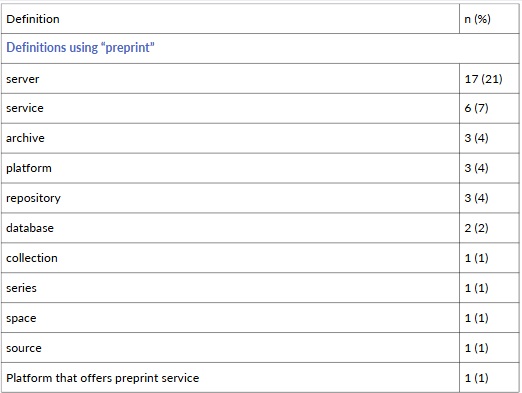
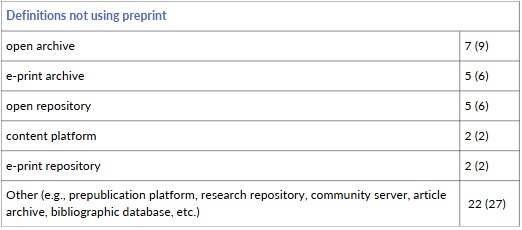
Some venues also used multiple terms at once. Organic Eprints, for example, describes itself as a growing “collection,” “archive,” or “repository”, while others defined themselves differently on different subpages, e.g., “We are an open-science platform ... .What is ResearchHub? A tool…”).
These labels may reflect differences in history, disciplinary culture, technical infrastructure, governance, or intended audience.

Each venue defines preprints in their own way
Only seven of the 82 venues displayed a definition of “preprint” on their main pages. Their definitions reveal several points of disagreement (Table 2).
Table 2. How preprint venues define “preprint” on their main pages.
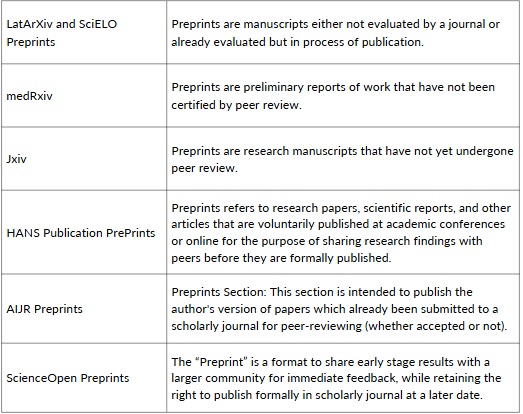
These definitions emphasize different characteristics. For example, medRxiv and Jxiv defined preprints as manuscripts that had not yet undergone peer review, while AIJR Preprints limited its definition to papers already submitted to a scholarly journal. ScienceOpen described preprints as a way to share early-stage results and receive feedback before journal publication. In contrast, LatArXiv and SciELO Preprints included both manuscripts that had not been evaluated by a journal and those that had been evaluated but were still awaiting publication.
Defining preprints by warning about them
Formal definitions are not the only way venues communicate how they conceptualize preprints. Warning labels also convey how a venue understands the status of the manuscripts they host. For this reason, we also examined whether and how venues used such labels.
Six venues displayed warnings on their main page about preprint information reliability. Recognizing that some users are likely to access preprints directly rather than via a server’s homepage, 22 venues included warning messages on individual preprint pages (we list examples of both types of warnings in Table 3 below).
Table 3. Examples of warning messages on preprint servers’ main pages and individual preprint subpages.
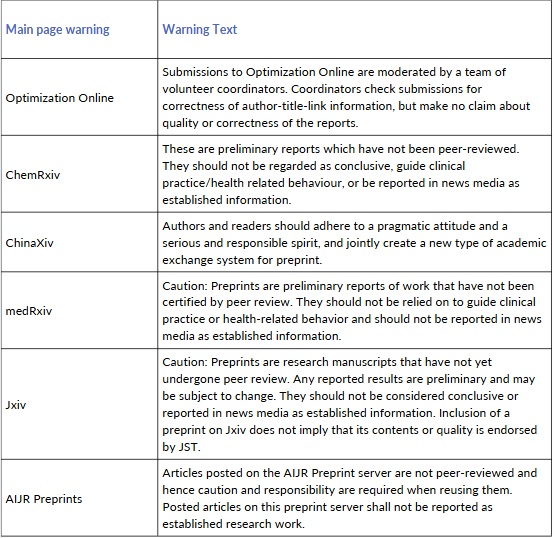
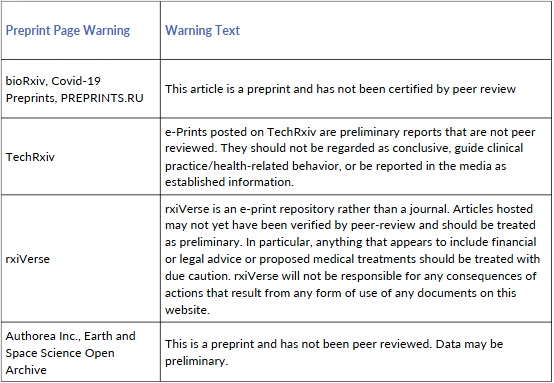
Most warnings emphasized that preprints had not been peer reviewed and should be considered preliminary. Some also cautioned readers not to treat their findings as conclusive, use them to guide health-related, financial or other important decisions, or report them as established findings.
Why definitions matter
This variation is not only a matter of terminology. How preprints are defined affects estimates of the size and growth of preprint publishing, comparisons across disciplines and countries, studies of publication speed and research dissemination, and analyses of the relationship between preprints and journal articles. It can also affect the visibility of particular platforms and communities, as well as policies related to research evaluation and open science. Before asking how preprints affect scholarly communication, we may, therefore, first need to ask what communities, platforms and infrastructures are counting as a preprint.
Recent changes in OpenAlex’s classification of scholarly works—which reduced the estimated number of preprints from approximately 10.1 million to 9.3 million[13]—illustrate the tangible consequences of how we define “preprint” for how scholarly communication is understood and analysed. This analysis also forms part of our broader work examining the relationship between preprints and versions of record, including by tracking changes between preprints and their corresponding published version.
This analysis represents one aspect of a broader database of preprint servers that we have compiled and coded. In future posts, we will draw on these data to examine other characteristics of preprint venues, including their governance and moderation practices.
References
[1] JAV Revision Working Group | NISO website n.d. https://www.niso.org/standards-committees/jav-revision (accessed July 9, 2026).
[2] q.e.d Science – an AI review tool for authors n.d. https://connect.biorxiv.org/news/2025/11/04/qed_review_tool (accessed July 8, 2026).
[3] Malički M, Jerončić A, ter Riet G, Bouter LM, Ioannidis JPA, Goodman SN, et al. Preprint Servers’ Policies, Submission Requirements, and Transparency in Reporting and Research Integrity Recommendations. JAMA 2020;324:1901–3. https://doi.org/10.1001/jama.2020.17195.
[4] Proposed Updates To Preprint Services Directory: Request For Comments – ASAPbio 2026. https://asapbio.org/proposed-updates-to-preprint-services-directory-request-for-comments/ (accessed July 16, 2026).
[5] Preprint Servers – ASAPbio 2025. https://asapbio.org/preprint-servers/ (accessed July 9, 2026).
[6] List of preprint repositories. Wikipedia 2026.
[7] Directory of Open Access Preprint Repositories: Home n.d. https://doapr.coar-repositories.org/ (accessed July 9, 2026).
[8] Santos GC, Santos GC. Repositório de Preprints. Guia de Fontes de Indexação. https://periodicos.sbu.unicamp.br/vocab_fi/vocab/ 2022. https://periodicos.sbu.unicamp.br/vocab_fi/vocab/?tema=227 (accessed July 9, 2026).
[9] OpenAlex: The open catalog to the global research system | OpenAlex n.d. https://openalex.org/ (accessed July 9, 2026).
[10] Feeney P. You are Crossref. Crossref n.d. https://www.crossref.org/ (accessed July 9, 2026).
[11] Vierkant P. DataCite – Connecting Research, Advancing Knowledge. DataCite n.d. https://datacite.org/ (accessed July 9, 2026).
[12] Guidelines for Registering DOIs for Research Da 2015.
[13] Demes K. An Overhaul of Type Classification. OpenAlex Blog 2026. https://blog.openalex.org/an-overhaul-of-type-classification/ (accessed July 16, 2026).
DOI: https://doi.org/10.59350/njn37-apm32


What VOICES Taught Us About Open Science and Inclusion in Times of Crisis
After three years of collaboration across four countries and multiple disciplines, the VOICES project has come to a close. Led by ScholCommLab co-director Juan Pablo Alperin, VOICES—short for “Value of Openness, Inclusion, Communication, and Engagement for Science in a Post-Pandemic World”—brought together researchers from Brazil, Canada, Germany, and the UK to investigate how open science (OS) was conceptualized, implemented, and communicated during the COVID-19 pandemic. Our goal was to capture how OS was taken up and understood across different national, institutional, and disciplinary contexts—and to trace how (and whether) principles of equity, diversity, and inclusion were reflected in those efforts.

What We Did
To explore these questions, we combined a range of methods—including bibliometric and altmetric analysis, qualitative content and document analysis, and stakeholder interviews. Across four interconnected work packages, we examined different facets of OS during the pandemic, including: how OS was framed in media, policy, and expert discourse; how the pandemic shaped publication practices; how OS was mediated in the form of press releases and science news coverage; and how media attention to preprints and platform moderation practices evolved amid concerns about credibility and misinformation.
Our approach was not only interdisciplinary but also multilingual and context-sensitive: we collected and analyzed data in English, German, Portuguese, and Spanish, examining OS practices and discourses across a range of institutional settings, national research systems, and media environments.
By coordinating data collection and interpretation across national teams, VOICES became one of the few comparative studies of COVID-era OS that integrated linguistic and regional diversity into its research design.
What We Found
A fuller account of our findings can be found in the final project report. Here, we share four key takeaways that surfaced across the project’s four work packages. Together, these findings show that while OS played a central role in the pandemic response, its implementation was often fragmented, temporary, and disconnected from broader goals of inclusion.
-
- Open science expanded during the pandemic—but unevenly
The pandemic spurred a rapid uptake of open practices like preprinting, data sharing, and public engagement. But this growth was far from uniform. The adoption of OS varied widely by country, language, and research field, and was often shaped by local infrastructure, policy environments, and institutional norms. These differences highlight the need for OS approaches that are flexible and responsive to diverse contexts.
-
- Openness didn’t always mean inclusion
Although OS was widely framed as a public good, definitions of “openness” varied—and rarely prioritized equity, diversity, or inclusion. These values often remained aspirational, reflected in rhetoric but absent from the systems that structure access and participation. Across the project, we found that openness was typically pursued to accelerate dissemination and increase visibility, not to broaden participation or redistribute power. The infrastructures that enabled OS during the pandemic were seldom designed with equity or public accessibility in mind.
-
- Emergency measures expanded access—but did only temporarily
At the height of the pandemic, research was made widely available—particularly through Bronze and Gold open access (OA)—as publishers lifted paywalls in response to global urgency. But as the crisis waned, so did the openness. Articles disappeared behind paywalls, and open access momentum slowed. This reversal exposed the fragility of temporary measures and underscored the need for stronger policies that treat OA as a durable public good, not a crisis exception.
-
- OS and science communication remained disconnected
The pandemic exposed an ongoing disconnect between OS and science communication. Even as OS outputs increased, they were not always accessible or legible to wider publics. Institutional communication framed openness as a public benefit, yet rarely addressed the question of who could make use of that openness in practice. Journalistic engagement with preprints brought greater visibility to OS but also surfaced concerns around credibility and trust in science. The initial surge in media attention to preprints faded over time, highlighting the temporary nature of OS’s prominence in the public sphere.
Our Takeaways
The pandemic demonstrated that OS can support more responsive, collaborative, and transparent science in moments of crisis. But it also revealed the limits of existing systems: participation remained uneven, access often depended on temporary policy shifts, and communication infrastructures struggled to bridge expert knowledge and public understanding.
While many OS practices gained momentum—especially early in the pandemic—much of that progress was ad hoc and difficult to sustain. Without stronger infrastructure, inclusive governance, and a deeper commitment to equity, the long-term potential of OS remains constrained. Put simply, to fulfill its promise, OS must be reimagined not just as a technical or policy shift, but as a political and social project that embeds inclusion into its goals, practices, and infrastructures from the outset.
Moving Forward
Preprints, in particular, emerged as a focal point during the pandemic—praised for accelerating knowledge dissemination, but also sparking debates about credibility, trust, and the responsibilities of those who share, moderate, and report on them. Yet their future remains ill-defined and uncertain. Journalists’ use of preprints is evolving, and preprint servers are navigating shifting moderation policies while being pulled in different directions by publishers, funders, and scholarly communities.
These developments have also placed preprints at the center of broader conversations about research integrity—how it is safeguarded, by whom, and under what conditions. In this contested space, integrity is not simply about the accuracy of individual papers, but about how preprints are positioned and governed as part of the scholarly record. These tensions have sharpened debates over how evaluation systems should adapt, and whether open or hybrid forms of review can improve rigour and efficiency, and help build trust in science.
Understanding the role of preprints in scholarly publishing and their intersections with review and evaluation processes is, therefore, more important than ever. Building on the insights from VOICES, the ScholCommLab is launching a new three-year project that will explore how preprints and open peer review are implemented across platforms and disciplines, how they are experienced by diverse stakeholders, and how these approaches influence the quality, fairness, and efficiency of scholarly communication.
Connect with our work! Subscribe to the ScholCommLab newsletter for the latest insights, updates, and more.
DOI: https://doi.org/10.59350/scholcommlab.5587